Korean American Books

Summaries and reviews of fiction and nonfiction books by Korean American authors,
books about Korean Americans and Korea, and Korean literature in English translation,
including some academic works and a sampling on the Korean War
Showing posts with label fiction. Show all posts

Wednesday, September 20, 2017

Shelter by Jung Yun


This acclaimed debut novel deserves all the great attention and accolades it's received. Both a turn-the-page thriller and a literary investigation of a family's survival from trauma, both recent and decades old, the writing elevates the story into deeper understandings of the nuances in family relationships and how they seep into every act of living. It is a refreshing change that Kyung's Korean-ness is not the central focus of the story, and his being Korean is only incidentally part of the narrative, an essential part of his identity, yes, but not the main focus. Yun also manages to make an unlikeable protagonist sympathetic, which is difficult to do, and at times uncomfortable to read. I found myself rooting for him to step up and overcome his history, but of course, he couldn't, just as all the others in the novel cannot deny how they were shaped because of their familial histories. Because the story is a thriller, I'm loath to reveal how the novel progresses, but it's a high recommendation that will keep you stuck to it until the last page is turned. 

Monday, June 5, 2017

A Small Revolution, by Jimin Han


In her startling debut novel, Jimin Han captures several genres at once—a terrifying thriller, a coming-of-age story of first love, a historical novel of 1980s Korea and Korean Americans, and a work of literature with an interesting structure and use of point-of-view that only ramps up the tension. I am reluctant to talk about the actual story so as not to ruin its surprising drama, though it has been often reviewed, but do want to say it’s a writer’s book and a compelling read as well. Who said fine writing couldn’t take one’s breath away with suspense and action?

Tuesday, May 23, 2017

Pachinko, by Min Jin Lee


The accolades for this fine, epic novel are deserved. In her second novel, author Min Jin Lee follows members of a family (and many equally fascinating ancillary characters) from the Japanese Occupation era in Korea, to the Korean diaspora in Japan, up to 1989. She manages this expansive timespan through third-person omniscient voice, allowing a kind of economy in the storytelling that would otherwise be limited to structural concerns. It’s both a feat of intricate character development and a rapid-moving plot that makes one love the people, even the antagonist, and live through a hundred fast-moving stories that kept pulling at me long after all the pages were turned. Much is written about her inspiration and about the story itself, so I leave this post brief, with a final urging to read this stunning book.

Friday, May 12, 2017

In the Shadow of the Sun, by Anne Sibley O'Brien


It’s been a while since I read a book, YA or adult, that captured me so thoroughly that I didn’t want to stop reading, and that I couldn’t stop thinking about until I finished reading it. IN THE SHADOW OF THE SUN was such a book. It follows Korean adoptee Mia Andrews and her brother Simon on a tour gone terribly wrong that devolves into a frightening and thrilling journey in one of the most closed countries on earth, North Korea. The author, who grew up in South Korea, has done thorough homework—the story feels authentic and the details ring with the truth of cultural accuracy and historical veracity. The book has a unique structure that includes a smart introduction to North Korea via a “travel guide,” and short interludes of voices of certain North Korean characters whom the youth encounter, if only briefly, on their harrowing journey. This combination brings a wider perspective on Mia and Simon's dilemma, and gives valuable glimpses of a varied and complex North Korean society and daily life. While the action is a page-turner, Mia’s inner journey of identity and courage, as well as Simon’s, and the shift in their brother-and-sister relationship is equally authentic and compelling. Mirroring today's political dilemma with issues of trust with North Korea, Mia and Simon are constantly confronted with questions about who to trust, and their instincts and choices are a lesson for us all. A terrific book about how a girl’s daunting journey enriches her inner journey, and a story and setting that expands one’s understanding of this country that is often in the news, and about which little is known.

Thursday, May 29, 2014

The Fruit 'n Food, by Leonard Chang

This early KA novel (first published 1996), centered around the Fruit ’n Food grocery, focuses on a somewhat aimless young man who gets involved with the grocer's daughter. The compelling story shows a Korean perspective of the race riots of the 1990s.

Saturday, April 12, 2014

A Gesture Life by Chang-rae Lee

Rich language describes a Korean-Japanese-American former WWII medic living quietly in Connecticut in a small provincial town. Because of his past in the Pacific War post of Burma in 1945, and the Korean comfort women there, he lives a gesture life, one where all is sacrified in order to fit in and have surface equanimity. His adopted Japanese daughter hates him; guesses that she serves some purpose in his life that has nothing to do with her. Townfolk support the lead characters with finesse--he avoids passion and loses love and living. Smoothly transitions to flashbacks from present-tense daily contemporary life. Lee excels in expressing nner emotion, grander themes and gravitas in soliloquies that ache the heart. Eloquent writing, dense and thoughtful.

Native Speaker by Chang-rae Lee

With this 1996 debut novel, Chang-rae Lee entered the pantheon of literary best-sellers. Part mystery, part spy story, part immigrant experience, the story examines the character and identity of Henry Park. With this character, Lee begins his theme of studying the externally remote, yet internally tortured man—one who is haunted by trauma or tragedy in the past, most often relating to events in Korea. The complexity of this novel, combined with Lee's signature muscular prose and precision sentences, have made it a continued excellent read.

Tuesday, December 18, 2012

Forgotten Country by Catherine Chung

Catherine Chung's acclaimed debut novel (a Booklist Starred Review, among other terrific press) earns its accolades with elegant prose and a story of an immigrant family. Set in both America and in Korea, Janie's complicated relationship with her missing sister, Hannah, stands as a metaphor for Janie's own complicated relationship with her parents and with her identity. The story examines the loyalties in family love, how they originate and how they evolve and affect each family member. Much of what makes this book sing is Chung's gorgeous writing and sensitivity to the subtle, and the leaps from a tiny moment of emotion that expands its meaningfulness to the universal, regardless of one's country of origin. 

Tuesday, September 18, 2012

I Am the Clay, Chaim Potok

An old woman and an old man flee from their village outside of Seoul (south of the river Han) when the Chinese join the North Korean People’s Army and invade Seoul for the second time. In the early days of their journey they find a boy, bleeding with a shrapnel wound, in a ditch. Having lost a son in childbirth, she rescues him more than once from the brink of death, her prayers to the spirits constant, while the old man resists helping this stranger. They struggle to survive crossing the mountains and the wretched last winter of the Korean War. In the old man's opinion the boy has special powers that have brought them meat and relative health. While the old woman finds peace in the belief that this is a son sent to her.

This intense character study of two simple people whose lives are utterly altered by war is deeply felt and written with power and grace, without attempting to soften the gruesome brutality of war. It is also an excellent point of view on the Korean War from peasants’ lives.

Excerpt from Chapter 3, page 63:

Fearful, they stood at the mouth of the cave staring into a darkness that would not open itself to their eyes. The dank fungus smell of sun-starved stones and earth brushed against their faces and filled their nostrils.

Knopf, 1992

Sunday, January 15, 2012

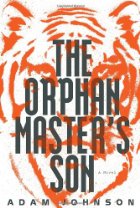
The Orphan Master's Son, Adam Johnson

Riding a crest of enormous praise, this debut novel by an American man about a North Korean citizen is a worthy achievement, and one I couldn't put down for two days straight. Its numerous twists of plot that in fiction often seem too coincidental, but the reader's sympathy and alignment to the protagonist is deeply enough felt that these happenstances feel mostly believable, and are almost forgivable. The dog, in particular, was over the top for me. The book paints a harsh reality of life under Kim Jong Il, and though I think there is much basis for the events portrayed in this novel, it seems still to be a decidedly Western take. The notorious North Korean extremism of the ideology and the brutality of prison camp life and interrogation techniques are undeniable, and feel thoroughly researched. My 2-star rating of the book relates to its core premise, which over time grew to be more difficult for me to swallow: the desire for freedom portrayed here is a Western sense of freedom; the striving is for an unknown entity of "freedom" by the North Korean people. Though Korea has a long history of oppression and suffering, our Western notion of yearning for freedom cannot be so easily applied to North Korean citizens. I lament how subtleties of Korean language and culture are unable to be captured, and how that lack of authenticity allows situations that would be rare if not impossible in that culture. But the book is a page-turning thriller, with a heroic man living under the pressure of exceptional times, undergoing gradual change that challenges his identity. Some of the characters, like the Captain and Mongyong, as well as minor incidental characters with mere walk-on roles, like the Japanese girl on the pier, are memorable. The telling of this story is structurally interesting (something the Pulitzer committee in the past several years seems to admire), interwoven by DPRK Citizen’s broadcasts, and with shifting points of view to bring in several aspects to present a communal take on an American writer's view of North Korea. I recommend instead the real-life story of Shin Dong-hyuk, in the book, Escape from Camp 14: One Man's Remarkable Odyssey from North Korea to Freedom in the West, by Blaine Harden.

NY Times January 15 review

Monday, November 7, 2011

Miles from Nowhere, by Nami Mun

With stunning prose and a sensitive eye for detail, Mun unfolds five years from age 14 in the gritty and difficult life of a young Korean American runaway on the urban streets. Not only does Joon quickly lose her innocence and succumb to the seemingly soothing beguile of drugs, leading to heroin addiction, she must fight for a lost identity as she attempts to reconcile being the daughter of an abusive and abandoning father, and a neglectful and strangely behaving mother who only has eyes for the father. Though what Joon lives through and what she remembers is horrific and exactly as awful as one imagines such a hardscrabble life can be, Mun's unsentimental take on it and her stunning prose that reaches deep into the core questions of what makes us continue when so much is lost, when even the self is seemingly without redemption, is what makes this book a breathtaking reward.

Tuesday, September 13, 2011

The Martyred by Richard E. Kim

Richard E. Kim’s book THE MARTYRED, a 1965 National Book Award Finalist, became a Penguin Classic book in May 2011 (pictured left). The introduction is by Heinz Insu Fenkl, with a Foreword by Susan Choi. This Korean War story follows Captain Lee who investigates the murders and kidnappings by North Korean Communists of Christian ministers and priests. As Lee investigates the depths of this crime, he examines the meanings of faith and martyrdom in a narrative that is both a thriller and a fascinating exploration of these themes. 

Monday, August 8, 2011

This Burns My Heart, by Samuel Park

This Burns My Heart captures you with a heroine who is both irresistible and flawed, and will engross with increasing twists in a triangle of love and sacrifice. The story explores how a fateful choice colors a decade of marriage, and challenges a young woman’s ambition already constrained by traditional Korean culture. Sam Park paints all the flavors of post-war Korea in this vivid debut, and his understanding and expression of the human heart is universal.

Sunday, June 5, 2011

Everything Asian, by Sung J. Woo

The name of the book is taken from the name of the store owned by the parents of the main character, Dae Joon (David). Father has been in America five years without his family setting up a business, and the book begins a month after the arrival of Mother, Dae Joon and his noona (older sister, In Sook--Sue). Struggling with language and assimilation, the reunion of the family, and the teenaged trauma that Sue expresses over having been wrenched from her life in Seoul at age 16, the story of this family is told with both humor and pathos. Point of view revolves with the chapters, touching on Father, Mother, and several other merchants in a rather tawdry kiosk-like mall. Except for one sexually graphic chapter of an American family with a grown son whose lives intersect for a moment with this Korean family, this novel could have easily been quite a successful YA book, as it’s a sensitive and authentic story of a young Korean boy’s coming-of-age struggle to find his place in the cloistered world of his family, and the beginnings of identity in a new country.

Wednesday, June 1, 2011

The Queens of Ktown by Angela Mi Young Hur


Told from the vantage point of the main character Cora, at age 16 and in her late 20s, the themes of this story are familiar. Both a coming-of-age and search-for-identity story not unusual for children of immigrants, the story begins with Cora witnessing a suicide, and then the time shifts chapter to chapter, somewhat confusingly, to months leading up to that suicide, many years after, and shortly after. Intertwined with this structure is Cora's family story of her mother gone to Seoul, allegedly to take care of her dying father, but in reality creating a marital separation. Cora’s father moves his two daughters to Brooklyn. Cora, already feeling disconnected with her KA identity and now apparently feeling abandoned, has reckless sex, rampant alcohol and drug use, and finds three new girlfriends that immerse her into the nightclub culture of Korea Town in New York City. The relationships and alliances of these friends shift, and Cora finds herself drawn, with disastrous results, to the girl who is the most recent immigrant, Soo Young, who speaks little English.

The beginning of the book is written sharply. It is intelligent with wit and refreshing insight into the Korean American youth 1.5-generation experience. The way the book is structured is challenging, as it wasn’t clear until the very end what the actual sequence of events was, leading to a sense of feeling lost that is reflective of the character's predominant state of being. Moments of Korean history are inserted as well as certain cultural iconography, such as shamanism, and these feel less like they derive from the character as they have the sense of feeling pasted in. Hur’s skilled prose is remarkable, and many will feel an alliance to the nightlife culture and the identity struggles of this protagonist.

Monday, May 9, 2011

Edinburgh, by Alexander Chee

I can’t believe I haven’t previously listed this prize-winning book, since I read it years ago shortly after its release in 2001, and have never forgotten it, especially that its prose was gorgeous. Edinburgh is a coming-of-age story about a Korean American twelve-year-old in Maine who is immersed in the culture of a boys’ choral group that has a pedophile teacher. Homosexuality, music, art and difficult subjects and scenes are written with detailed prose that give insight into these difficulties with masterful complexity. Pervasive themes of light, music and fire give luminescence to the story and lift the horror and darkness of the dramatic action into nuanced sensitivity.

Chee has an informative and entertaining blog, Koreanish, that covers numerous literary topics as well as just plain interesting subjects.

Friday, July 9, 2010

Long for This World by Sonya Chung

This debut about a young woman grieving from multiple loss and tragedies delves into the lives of all the members of her extended family, and spans two continents (Korea, America) and multiple periods of time. The novel is structured in the manner of associative thinking patterns--from one point of view to another, from one time period to the past or the future, not strung together chronologically or sequentially in the plot, but by a certain thought or a thread in a moment or a scene. The construction and pace of the story are driven more by emotional thrust and internal change than by action and plot, though there’s action enough. Because the writing is character-driven and Chung’s impressions and imagery are stunning, the book’s structure works to enhance those qualities. The list of characters at the beginning of the book is especially helpful for readers not familiar with Korean names, which can appear similar and confusing. Chung's diction has a stiff sense of formality that emphasizes the complex culture of social layers and formality that are embedded in Korean language and speech. Her character studies are moving, poignant, sensitive and the writing about each individual's struggle is deeply felt and visually expressive.

Saturday, April 10, 2010

The Surrendered by Chang-rae Lee

What happens to life after you survive the atrocities and randomness of war? Chang-rae Lee examines the deep intricacies of this question and its ramifications in THE SURRENDURED, portraying three survivors (Korean War, China-Japan War) whose lives mesh at an orphanage somewhere in South Korea after liberation. From that common crossroad, the lives of Sylvie, a missionary wife, Hector, a G.I., and June, a Korean orphan, are forever intertwined, shadowed by pervasive doom pitted against the human need to endure. 

Lee’s strength has always been with his exceptional prose—the constantly surprising and original use he puts to words—and a sheer magnificence in the way those mere words rise up to deliver stunning revelations of simple truths in what makes us human. This book is rich in that tradition. I have tagged more than one hundred sections that moved me to wonderment. It’s also probably the most physical and sensory book I have ever read, especially redolent in smells. There’s a lot of sex and vivid description of sensation, and Lee’s intense focus on physicality in itself seems to reflect the characters’ bodily will to continue life, even as their hearts are blackened by tragedy. 
It is an intense and absorbing read, frightening for what we do to ourselves and how, despite all the darkness and violence we create in the name of war, some continue to persist in a semblance of life, and helplessly pass along the damage of war to those they touch as they reach out with a last shred of hopefulness. Is it all in vain? That’s the question Lee poses in this masterpiece of writing.

Thursday, February 4, 2010

Sondok: Princess of the Moon and Stars, by Sheri Holman

(Young Adult) The coming-of-age fiction, told in diary form, explores the life of Korean Princess Sondok (595 AD) during the Three Kingdom period of ancient Korea before she became the first reigning queen of Silla in 632 AD. During a period of rife factionalism between Buddhism, Confucianism and Shamanism/Animism, young princess Sondok finds peace in the studying the stars. Barred as a female from formal education, Sondok manages to learn from a Chinese envoy and discovers astronomy. The story is of an adolescent girl who investigates issues of warring faiths in her time, and who ultimately becomes queen to a period when Buddhism will flourish and the remarkable astronomical observatory that still stands today in Korea will be built.

To Swim Across the World, by Ginger Park

A fictionalized biography of the lives of the parents of authors Frances and Ginger Park. Told in the alternating viewpoints of the boy and girl, the story also traces historical information about relevant Korean history as the narrators come of age, survive the Korean War, fall in love, immigrate to America, assimilate and explore Christian faith. Frances Park’s debut novel is When My Sister Was Cleopatra Moon, and she and her sister Ginger co-authored the children’s book, My Freedom Trip: A Child’s Escape from North Korea.